
AI Software & Enterprise AI Weekly · Issue 015
Enterprise AI billing is easier to examine; revenue and cash returns still need evidence
AI Software and Enterprise AI Weekly, Issue 015. Original research window: November 10–17, 2026. Delayed-publication review: November 22. The review is distinguished from events within the original window.
10-second view
Clearer measurement helps verification; paid adoption, full costs and cash recovery remain separate tests.
One-minute research brief
Usage-based billing creates a clearer measurement interface for enterprise AI. It does not establish incremental revenue, margins or free cash flow. Paid adoption, retention and full delivery costs still require evidence.
This issue follows enterprise usage measurement and ServiceNow's CRM migration capabilities. Reading a billing rule does not establish that it was first introduced that week. The ServiceNow event is tied to its dated November 12 controlled-availability announcement.
Audio summary
Synthetic narration · transcript below
Read the full audio transcript
This is the public summary of AI Software and Enterprise AI Weekly, issue fifteen. The original research window was November tenth through seventeenth. The delayed-publication review is dated November twenty-second. Enterprise AI usage is becoming easier to examine, but clearer bills do not establish revenue, profit or free cash flow growth. Agreement eligibility, seats, minimum commitments and actual consumption need separate verification. The rate card read by the original report has changed, so this edition does not repeat old prices or treat a reading date as a launch date. ServiceNow's November twelfth CRM migration announcement described controlled availability, not general availability. Follow task success, paid adoption, retention, implementation costs and cash recovery. Selling prices are not inference costs, and contractual commitments are not recognized revenue. No verifiable original technical or commercialization scores were obtained. This issue is not scored. A changing page is not a historical snapshot. This is research, not investment advice.
Deep dive
CONTINUITY & CHANGE
From the previous issue to this one
Separate dated product events, document reading dates and the delayed-publication review.
AI Software Weekly 014 · 10 NovemberUsage measurement
- Baseline / context
- The research baseline separated seats, commitments and usage.
- This issue
- Issue015 examines the boundaries of eligible token-based agreements.
- Interpretation
- A billing interface does not establish recognized revenue or margins.
CRM delivery
- Baseline / context
- Enterprise adoption required deployment and operational evidence.
- This issue
- ServiceNow issued a dated controlled-availability announcement on November12.
- Interpretation
- Product scope is clearer; actual delivery and cash contribution still need evidence.
The dynamic OpenAI pages are linked in the deep dive, but their reading dates are not presented as launch dates. No numeric score is inferred.
Clearer measurement still depends on the agreement
OpenAI's enterprise billing explanation concerns eligible Enterprise agreements, not an automatic migration of every customer. Usage charges, seats and contractual commitments need separate treatment. ChatGPT and API reports also have different boundaries.
Research should test paid consumption, discounts, budgets and contract duration. A minimum-spend commitment cannot simply be relabeled recognized revenue or high-quality annual recurring revenue.
An earlier rate card is not a fixed quotation today
The internal research read the enterprise token rate card on November 17. At the November 22 review, this changing page included updated models and promotional conditions. Its current state does not establish when every rate became effective within the original window.
This public edition therefore omits the internal numeric price table and does not generalize speed multipliers across every model or indefinitely. Applicable pricing requires the agreement and relevant date. Selling prices are not underlying inference costs: model selection, task success, retries, caching and human review can change economics per completed task.
CRM migration requires delivery and adoption evidence
ServiceNow's November 12 announcement described Autonomous CRM Engine as being in Controlled Availability. It outlined process discovery, deployment and configuration monitoring. Controlled access is not general availability, and a vendor's proposed implementation timeline is not an achieved outcome for every project.
Customer statements provide adoption leads, but the announcement does not establish attributable revenue or cash contribution. Follow project acceptance, post-migration retention, attributable revenue and delivery costs.
Follow the chain from capability to cash recovery
Technical tracking concerns task quality, auditability and operational reliability. Commercial tracking concerns paid adoption, renewals, net expansion and cost attribution. An undefined score cannot substitute for either. No verifiable original technical or commercialization score was obtained for this issue; the status is "Not scored this issue."
If consumption fails to produce durable revenue, or inference and implementation costs grow faster, the commercial thesis needs re-examination. This edition does not derive company valuation, earnings forecasts or trading conclusions from a rate card.
VALUE CAPTURE
Where is the evidence between capability and cash?
Follow the evidence for this issue; no company ranking, target price or guaranteed financial outcome is implied.
Capability and distribution
Metering documentation and a controlled CRM product announcement are available.
Task success, scope and operating reliability.
Paid usage and contracts
Contract eligibility, seats and usage have distinct meanings.
Actual consumption, discounts and retention.
Revenue
A price list or commitment is not recognized revenue.
Attributable revenue and renewal evidence.
Costs and margins
Selling rates do not establish inference or implementation costs.
Full task costs, including retries and human review.
Cash
This issue does not quantify incremental cash contribution.
Cash collection, investment needs and sustainable recovery.
INDUSTRY & COMPANIES
Technical progress and commercialization
Track enterprise software delivery and model usage economics separately. No verifiable original technical or commercialization score was obtained.
Not scored this issue. No missing metric is recalculated or inferred from a product launch.
Industry coverage
Enterprise AI measurement
Eligible agreement rules provide a measurement framework.
Real consumption, discounts and cost attribution remain necessary.
Agentic enterprise workflows
The November12 announcement describes CRM discovery, deployment and monitoring.
Acceptance, retention and attributable cash remain to verify.
Companies to follow
OpenAI
Enterprise usage measurement and agreement applicability.
- Technical evidence
- Track task quality, model mix and operational reliability.
- Commercialization evidence
- Billing documentation does not establish revenue or cash growth.
- Technical / commercialization score
- Not scored this issue
- Next verification
- Actual adoption, budgets, retention and full task costs.
ServiceNow
CRM migration and configuration monitoring.
- Technical evidence
- Preserve controlled availability and vendor-claim boundaries.
- Commercialization evidence
- The announcement does not establish attributable financial contribution.
- Technical / commercialization score
- Not scored this issue
- Next verification
- Delivery acceptance, customer retention and implementation economics.
THE CORE DIAGRAM
Evidence and validation boundaries
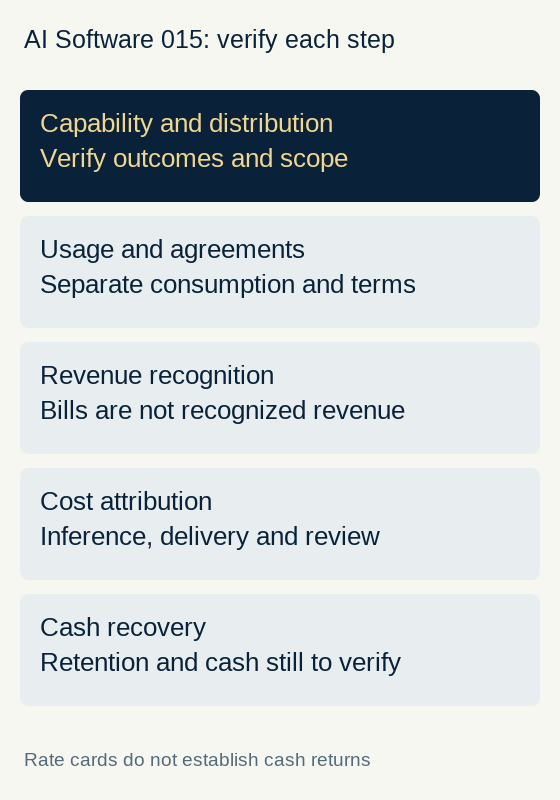
Read the diagram as text
- Capability and distribution: verify outcomes and scope
- Usage and agreements: separate consumption and terms
- Revenue recognition: bills are not recognized revenue
- Cost attribution: inference, delivery and review
- Cash recovery: retention and cash still to verify
FAQ
Frequently asked questions
Does token billing mean every enterprise customer changes price together?
No. Applicability and actual terms depend on the agreement.
Does a rate card prove revenue or profit growth?
No. Actual consumption, discounts, revenue recognition and costs remain necessary.
Is controlled availability the same as general availability?
No. Retain the announcement's scope and verify subsequent changes.
Does this issue assign November 22 information to November 17?
No. The November 12 event, November 17 reading and November 22 publication review are distinguished. A changing web page is not a historical snapshot.
KEY TERMS
A quick reader’s glossary
- Token
- A unit used for model input and output measurement; not a unit of completed business value.
- Seat fee
- A contractual charge distinct from actual usage.
- Commitment
- A spending obligation whose recognition and settlement depend on the agreement.
- Controlled Availability
- A limited availability scope; not general availability.
- Inference cost
- A cost concept requiring evidence beyond the selling rate.
- FCF
- Free cash flow cannot be derived from prices, product launches or customer quotations alone.
SOURCES & CONTINUITY
Sources readers can verify
Evidence dates and reading boundaries
- ServiceNow's dated November 12 announcement falls within the original research window.
- The internal report records reading the OpenAI help pages on November 17; that is not evidence of a first launch that day.
- The November 22 review prevents reuse of stale pricing. It does not rewrite an earlier issue or establish that all subsequent developments were exhaustively checked.
- Public research only; not investment advice.