
QUANTUM COMPUTING RADAR · ISSUE 012
Quantum Computing Radar 012: GPU decoding advances; the commercial loop remains open
Research window: November 13, 17:00 to November 20, 16:58, 2026, Beijing time.
10-second view
GPU decoding evaluation has advanced. Live-system performance, operating costs and attributable cash flow remain unproven. Nighthawk is historical support, not a new event this week.
One-minute research brief
The new development this week is the November 16 release of Pelagos, IBM and AMD’s open-source framework for GPU-based quantum error-correction decoding evaluation. It helps researchers test decoders more efficiently. It does not establish that a commercially viable fault-tolerant quantum computer is operating.
Three layers need separate evidence: errors produced by a quantum processor, the classical computation that decodes those errors, and customers’ willingness to pay repeatedly. Faster computation in one stage does not demonstrate an advantage for the complete system, revenue growth or free cash flow.
IBM’s November 11 Nighthawk announcement predates this issue’s window. We include it as historical context, rather than a new event this week. Two November 12 preprints are also historical technical support.
Audio summary
Synthetic narration · transcript below
Read the full audio transcript
Quantum Computing Radar, issue twelve. Our research window is November thirteenth through twentieth, twenty twenty-six. The new evidence this week is the November sixteenth release of Pelagos, an open-source framework from IBM and AMD for evaluating quantum error-correction decoders on GPUs. This is a research tool, not proof that a commercial fault-tolerant quantum computer is operating. The November eleventh Nighthawk announcement and two November twelfth preprints are historical context, not new releases within this week’s window. Keep three layers separate: quantum hardware, classical decoding, and customers paying repeatedly. A faster stage of a benchmark does not establish a whole-system advantage, revenue growth or free cash flow. The next checks are end-to-end latency, decoding quality, operating cost and verifiable commercial use. Our conclusion: evaluation capability has progressed, but the commercial loop remains open. This audio uses synthetic speech and is for research discussion, not investment advice.
Deep dive
CONTINUITY & CHANGE
From the previous issue to this one
We retain the previous issue’s distinction between capability, orders and cash. This issue adds engineering evaluation evidence; results from different companies or stages are not added together.
Revisit Issue 011: Quantum Orders and Government Capital Improve, but Revenue and Cash Burn Still Limit ReturnsResearch focus: add engineering evaluation to the commercial lens
- Baseline / context
- Issue 011 distinguished orders, government capital and cash consumption.
- This issue
- Issue 012 adds the Pelagos GPU decoding evaluation framework and simulation benchmarks.
- Interpretation
- This adds engineering evidence, rather than a numerical upgrade to a consistent set of commercial metrics.
Chronology: keep new events separate from historical support
- Baseline / context
- The November 11 Nighthawk announcement and November 12 preprints are added here as historical material.
- This issue
- The November 16 Pelagos framework release falls within this issue’s research window.
- Interpretation
- Earlier material can improve understanding without being counted again as a new event this week.
This is a qualitative comparison. No maturity score has been recalculated or added; stronger technical evidence does not establish stronger investment eligibility.
New this week: more scalable decoding evaluation
IBM’s November 16 explanation describes Pelagos as a GPU framework for large-scale decoding evaluation, built with Triton and released as open source. Its immediate contribution is to research: running simulations and comparing decoder performance more efficiently.
That is a useful engineering step. It is also narrower than a complete operating system. Processing batches of simulated error patterns does not, by itself, establish that a decoder meets the feedback deadlines of a continuously operating quantum processor. Performance claims need their hardware, baseline and measured stage attached; a decoding result should not be presented as a speedup for a complete quantum application.
Read the numbers at the correct boundary
The Scaling Pêlagos v1 abstract reports optimized end-to-end simulation speedups of 5.68–7.01 times for eight AMD GPUs against one GPU under the tested conditions. Measuring GPU decoding time alone gives 7.45–7.58 times for the two-gross tests. The first includes host overhead; the second isolates decoding. Neither is a whole-application quantum speedup, and results from different codes, devices and conditions should not be combined into a guaranteed operating result.
Historical context: hardware roadmaps still need delivery
IBM’s November 11 Nighthawk announcement outlines further hardware expansion. It provides context for the direction of development, rather than proof that future fault-tolerant capacity has already been delivered. Physical or programmable qubit counts should not be treated as counts of logical qubits.
Two November 12 preprints—Scaling Pêlagos and Hierarchical Decoding for Quantum Error Correction—provide technical support. Their earlier appearance and the November 16 framework release are separate events. Preprints and company explanations also remain distinct from independent replication.
The next evidence to watch
First, end-to-end latency: the time from real error information to a usable correction result, rather than GPU kernel speed alone.
Second, quality and cost: whether faster processing preserves decoding quality, and how much computation, memory, data transfer and energy it requires. Higher throughput purchased with more resources is not automatically a better operating outcome.
Third, commercial attribution: repeated paid use, durable revenue and attributable cash generation after costs. The technical sources reviewed for this issue do not establish that this commercial loop is complete.
Our assessment is that evaluation capability has progressed while commercial conclusions remain open. This is an assessment of the evidence, not an earnings forecast or investment recommendation.
VALUE CAPTURE
Where is the evidence between capability and cash?
This matrix describes the evidence in the reviewed sources. Unestablished attribution does not mean a company has no business, and tool performance is not treated as a commercial outcome.
Capability
A GPU decoding evaluation tool and simulation benchmarks are available.
Independent replication, live-system end-to-end latency and decoding quality.
Orders
The technical material does not connect this tool to customer orders.
Verifiable paid use, contract conditions and repeated use.
Revenue
The reviewed material is insufficient to establish quantum-revenue attribution.
Disclosures connecting actual use with recognized revenue.
Profit
This issue does not establish a complete operating-cost basis.
Compute, memory, data-transfer and energy costs, with decoding quality maintained.
Cash
Attributable free cash flow is not established in this issue.
A verifiable bridge between revenue, costs and sustained cash generation.
INDUSTRY & COMPANIES
Technical progress and commercialization
This module summarizes coverage in the materials reviewed for Issue 012. It is not a complete industry ranking; technical evidence, commercialization evidence and scores are shown separately.
Not scored this issue: a verifiable Issue 012 internal technical/commercialization scorecard and methodology were not available in the readable materials. This does not establish that the original internal research has no scores. Issue 011 scores are not carried forward.
Industry coverage
Error-correction software and classical computing
This issue covers the Pelagos GPU decoding evaluation tool and simulation benchmarks.
Real-system latency, independent replication, quality and cost remain to be verified.
Quantum hardware and systems
Nighthawk is historical support dated November 11.
Roadmap targets are not delivered fault-tolerant capacity; logical qubits and operating conditions require verification.
Commercial applications and paid adoption
The technical materials do not establish attribution between customer usage and financial outcomes.
Track repeat paid use, contract terms, revenue recognition, operating costs and cash flow.
Companies to follow
IBM
Covered: Pelagos. Nighthawk is historical support.
- Technical evidence
- Evaluation tools and a hardware roadmap provide technical evidence, not proof of an operating commercial fault-tolerant system.
- Commercialization evidence
- This issue has not verified attributable customer revenue or quantum-business cash flow.
- Technical / commercialization score
- Not scored this issue
- Next verification
- Independent replication, end-to-end latency, actual usage and financial disclosures.
AMD
Covered: the Pelagos GPU evaluation environment.
- Technical evidence
- Retains the manuscript’s distinctions between one and eight GPUs, simulation and decoding measurements.
- Commercialization evidence
- This issue does not link GPU test performance to quantum-business revenue or profit.
- Technical / commercialization score
- Not scored this issue
- Next verification
- Quality and resource costs across workloads, and verifiable commercial attribution.
D-Wave, Rigetti and Quantum Computing Inc. (QUBT)
Company updates are not covered this issue; Issue 011 remains historical reading.
- Technical evidence
- Issue 012 has not verified comparable current technical updates for these companies.
- Commercialization evidence
- Latest orders, revenue and cash burn have not been checked for Issue 012. Prior-issue figures are not presented as current conclusions.
- Technical / commercialization score
- Not scored this issue
- Next verification
- Add updates only after obtaining current internal research and original disclosures; no cross-company ranking is made.
THE CORE DIAGRAM
Evidence and validation boundaries
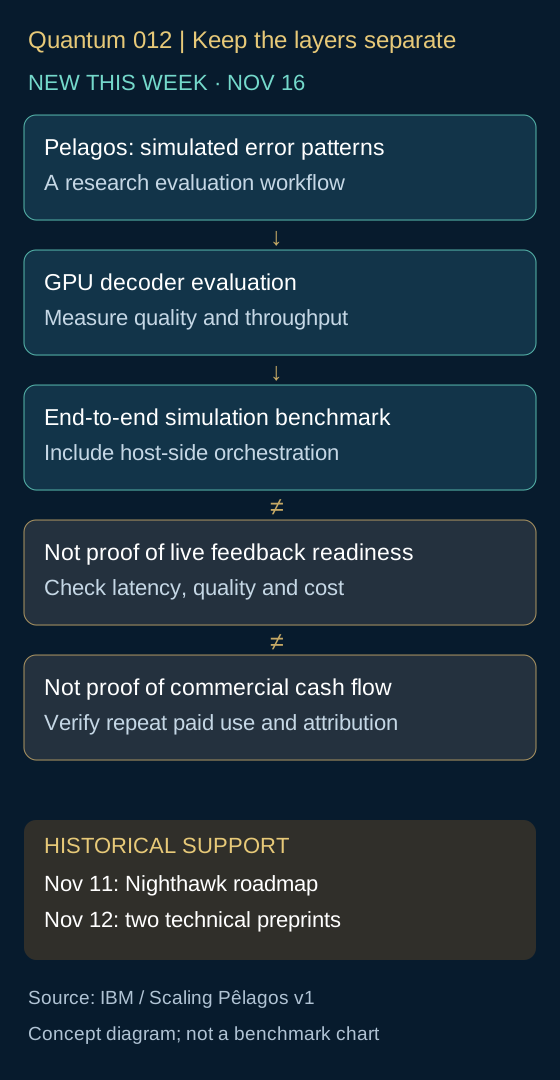
Read the diagram as text
- Quantum 012 | Keep the layers separate
- NEW THIS WEEK · NOV 16
- Pelagos: simulated error patterns
- A research evaluation workflow
- GPU decoder evaluation
- Measure quality and throughput
- End-to-end simulation benchmark
- Include host-side orchestration
- Not proof of live feedback readiness
- Check latency, quality and cost
- Not proof of commercial cash flow
- Verify repeat paid use and attribution
- HISTORICAL SUPPORT
- Nov 11: Nighthawk roadmap
- Nov 12: two technical preprints
- Source: IBM / Scaling Pêlagos v1
- Concept diagram; not a benchmark chart
FAQ
Questions readers may have
Does Pelagos establish commercial quantum computing?
No. An open-source evaluation framework and a sustainably paid fault-tolerant service are different achievements.
Why does quantum error correction involve GPUs?
Decoding is classical computation, and GPUs can parallelize parts of it. Suitability for a particular live system still depends on latency, quality and resource constraints.
Why discuss Nighthawk in this issue?
It supplies historical context. We retain the original November 11 date and do not reclassify it as a new development this week.
What would strengthen the commercial case?
Reproducible end-to-end results, operating costs, sustained customer use and disclosures that connect activity to financial outcomes.
KEY TERMS
A quick reader’s glossary
- Quantum error correction (QEC)
- Redundant encoding used to detect and correct errors in quantum information. It does not eliminate all noise.
- Decoder
- A classical computing program that infers likely errors from measurement information and supplies results to the correction process.
- End-to-end latency
- The total time from reading error information to a usable correction result. Measurement endpoints and included overheads need to be stated.
- Throughput
- The number of tasks or samples processed per unit of time, rather than the waiting time for one result.
- Logical qubit
- A unit of quantum information protected by error-correction encoding. Physical or programmable qubit counts are not a substitute.
- Free cash flow (FCF)
- Usually operating cash flow less capital expenditure. Comparisons still require checking each company’s specific definition.
SOURCES & CONTINUITY
Sources readers can verify
- NEW THIS WEEKIBM | Pelagos decoding evaluation at scale
- HISTORICAL SUPPORTIBM | Nighthawk progress and expansion roadmap
- HISTORICAL SUPPORTScaling Pêlagos | preprint v1
- HISTORICAL SUPPORTHierarchical Decoding for Quantum Error Correction | preprint v1
Evidence chronology and limits
- New this week: November 16, the Pelagos framework release described by IBM.
- Historical support: November 11, the Nighthawk announcement; November 12, the two preprints.
- The official Pelagos repository is a reference for future replication. It changes over time; its current branch is not treated here as a frozen historical version.
- We have not independently reproduced the GPU benchmarks or verified customer revenue or quantum-specific cash flow. Unverified outcomes are not presented as achieved results.