DBS and J.P. Morgan open a US–Singapore deposit corridor, giving companies a bank channel for on-chain dollars
Stablecoin and Onchain Finance Weekly 008 | Public Research · Bank Payments and Corporate Treasury | November 10–17, 2026
DBS Bank and Kinexys, J.P. Morgan’s institutional blockchain platform, have opened a cross-bank corridor for tokenized US dollar deposits between the United States and Singapore. Ant International is the first corporate client to use it. The corridor gives participating banks a way to offer cross-bank on-chain dollar transfers through existing account relationships. The first client establishes a live commercial use case. Transfer volumes, pricing and the impact on payment stablecoins remain open questions. November 16, 2026 joint announcement
Three signals
- The framework has entered commercial operation. The banks announced an interoperability framework in 2025 and opened the US–Singapore dollar corridor in 2026. Framework announcement · Launch announcement
- The first customer has a treasury use case. Ant International uses the corridor to manage cash and liquidity across its US and Singapore entities. The announcement gives no figures for usage frequency, payment volumes or retention. Launch announcement
- Banks have a direct distribution channel. Existing account and treasury relationships give banks a way to offer clients on-chain dollar liquidity. ACIS expects competition to show up first in client access, funding hours and service costs. Channel share remains unverified.
One-minute research brief
Issue 007 established that payment networks had reported institutional participation and measures of payment scale. The link from payment volume to platform net revenue and free cash flow remained unproven. This week adds evidence on the bank side. A cross-bank service between permissioned networks is in commercial operation and has a corporate user. The review window yielded no new financial disclosures sufficient to revise the economics of stablecoin issuance and distribution, and no material formal rule change that altered the prior analytical baseline.
How the corridor works
- Cross-bank transfer — DBS tokenized dollar deposit account ⇄ settlement coordinated by Partior ⇄ Kinexys blockchain deposit account.
- Account funding — traditional demand deposit account ⇄ Kinexys blockchain deposit account. The announcement specifies a weekly outage for movements between these accounts from 3 to 6 p.m. US Eastern time on Saturdays. Transfers within the Kinexys blockchain deposit account network are available around the clock. Launch announcement, including note 2
The next test is whether additional clients use the service repeatedly and whether transfers extend to third-party suppliers or merchants. Transfers between entities in the same corporate group establish a treasury use case. Sustained third-party payments would support a direct comparison with payment stablecoins in those workflows.
Audio summary
Synthetic narration. The transcript is available below.
Read the full audio transcript
This is issue eight of Stablecoin and Onchain Finance Weekly. DBS Bank and Kinexys by J. P. Morgan have opened a cross-bank corridor for tokenized dollar deposits between the United States and Singapore. Ant International is the first corporate client, using the service to manage cash and liquidity across the two markets. The service gives banks a direct channel for on-chain dollars through existing account relationships. One weekend restriction remains. Moving funds between traditional demand deposit accounts and Kinexys blockchain deposit accounts pauses on Saturdays from three to six p.m. U.S. Eastern time. The first client establishes a live treasury use case. The next evidence to watch is sustained use by more clients, payments to third parties, and disclosures on volumes, fees, and cash flow.
Deep dive | Where banks could earn economic returns
- Issuance. Stablecoin economics still depend on net reserve income, redemptions and distribution costs. Bank products also involve deposit liabilities and capital treatment. The launch gives no comparable financial figures.
- Custody and accounts. Banks can manage client identity, deposits and liquidity through existing account relationships. Balance ownership, fee arrangements and capital requirements still need disclosure or verification under the applicable terms.
- Distribution. Banks can offer on-chain dollar services through existing corporate relationships. Open networks can compete on reach across platforms. Comparable figures for channel cost and share remain unavailable.
- Application. The first client provides a commercial example of cross-time-zone treasury management. Transfer amounts, repeat use, third-party payment volumes and realized savings remain unverified. Launch announcement
Scenarios and counterevidence. Repeat use by several companies, alongside disclosed balances, fees or non-interest income, would strengthen the case that banks can earn sustainable returns from the service. If adoption spreads slowly and disclosure stays limited, bank corridors and stablecoin networks can continue to coexist, with competition centered on corporate access. The case for replication would weaken if usage stays concentrated in one client, weekend funding constraints leave clients pre-positioning cash, or cross-border compliance, fraud, redemption or liquidity events disrupt service. Partior’s settlement coverage and the operational impact of the funding outage are also worth tracking.
Risk and scope. Deposit insurance, capital treatment, anti-money-laundering obligations and cross-border redemption rights depend on the legal entity, customer and product terms. Public disclosures leave net flows from stablecoins, platform net revenue, operating cash flow and free cash flow effects unverified. This week’s evidence advances the assessment of commercial deployment.
Frequently asked questions
What form of dollars does the corridor use? It connects tokenized deposit accounts at two banks. The deposit value remains tied to the participating bank’s account, customer identity and deposit liability. Framework announcement
Can clients fund a blockchain account from a traditional account at any time on weekends? Kinexys discloses a three-hour Saturday outage for transfers into and out of its network from traditional accounts. Funds already inside the blockchain deposit account network can move under its round-the-clock transfer schedule. Launch announcement, note 2
How does the launch affect payment stablecoin competition? Corporate clients have a direct way to move on-chain dollars through participating banks. Third-party payment activity, reach, usage and total costs will help establish how the channels compete.
What data would substantiate commercial returns? Active clients, repeat transactions, transfer amounts, deposit balances, fees and attributable net revenue would help establish usage and monetization. Operating and free cash flow would help show whether those returns translate into cash.
Corridor diagram
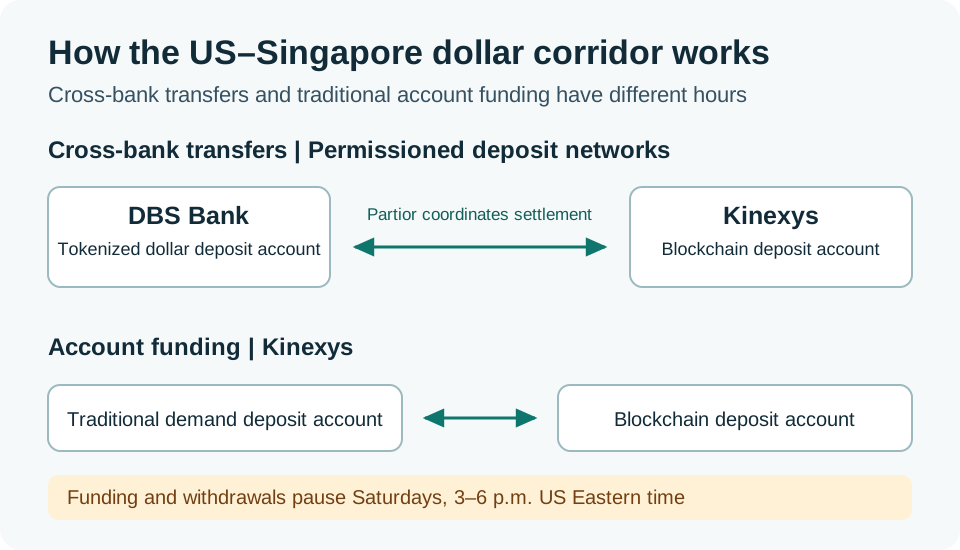
How the US–Singapore dollar corridor works
Cross-bank transfers and traditional account funding have different hours
Cross-bank transfers | Permissioned deposit networks
Tokenized dollar deposit account
↕ Partior coordinates settlement
Blockchain deposit account
Account funding | Kinexys
Funding and withdrawals pause Saturdays, 3–6 p.m. US Eastern time